

Knowing how to check gold purity is important before buying, selling, exchanging or evaluating gold jewellery. A necklace may look beautiful, a ring may have an expensive finish, and a chain may appear genuine, but appearance alone cannot tell you the actual gold purity.
Gold buyers commonly search for gold purity check, gold purity test, 916 gold, 750 gold, BIS hallmark, and HUID number when researching jewellery. Understanding these terms can help you examine your jewellery more carefully and ask better questions before making a purchase.
For customers searching for gold jewellery in Vijayawada, knowing the basics of purity can make jewellery shopping more transparent. Whether you are considering a chain, ring, necklace, pendant, bangle or earrings, purity is one of the details worth checking alongside weight, design and price.
BIS explains that hallmarking is the accurate determination and official recording of the proportionate content of precious metal in precious-metal articles. In India, gold and silver are currently covered under the hallmarking system.
How to Check Gold Purity Using the Hallmark
One of the simplest ways to start a gold purity check is by looking for the applicable hallmark markings on the jewellery.
The current BIS hallmark for gold consists of three main components: the BIS logo, the purity of the article expressed in caratage and fineness, and a six-digit alphanumeric HUID number.
That means you should not look only for a number such as 916 or 750. You should also understand the other markings that form part of the hallmark.
A properly understood hallmark can help you determine what purity the jewellery is marked as and give you an identification number that can be verified through BIS facilities.
The hallmark itself is not simply a decorative stamp. It is part of the consumer-protection framework around precious-metal purity.
What Do 916 and 750 Mean in Gold?
Two of the most familiar gold-purity markings are 916 and 750.
A fineness of 916 corresponds to 22-karat gold, while a fineness of 750 corresponds to 18-karat gold. BIS lists both 22K(916) and 18K(750) among the permitted gold hallmarking grades.
When you see 22K916, the marking communicates both the caratage and fineness.
When you see 18K750, it represents 18-karat gold with a fineness of 750.
Understanding these markings is one of the easiest starting points for anyone learning how to check gold purity before buying jewellery.
How to Identify 22K Gold and 18K Gold
If you are trying to understand how to identify 22K gold, look at the applicable purity marking and hallmark rather than relying only on colour.
22K gold is commonly associated with 916 fineness.
18K gold is commonly associated with 750 fineness.
The difference matters because the two purity levels contain different proportions of gold.
Customers choosing traditional jewellery may come across many 22K916 designs, while contemporary jewellery collections may also include 18K750 pieces.
The right option depends on the product, intended use, style and customer preference.
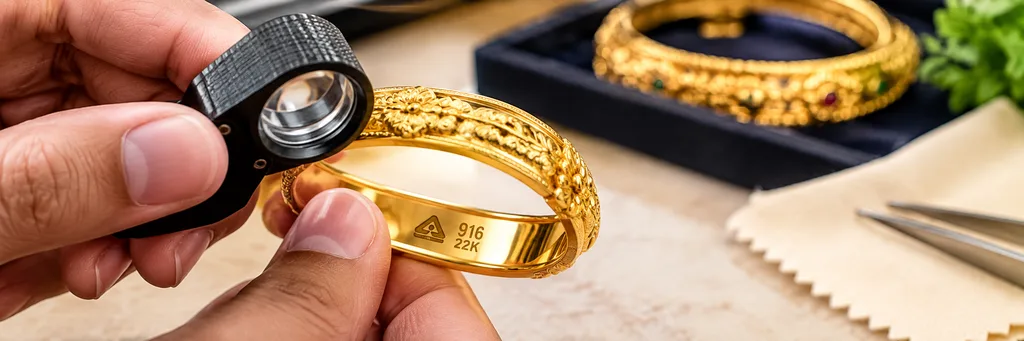
Can You Check Gold Purity at Home?
Many people search for check gold purity at home, especially when they already own old jewellery.
There are simple visual checks you can perform yourself, but these checks should not be confused with professional purity testing.
At home, you can inspect the jewellery carefully for the applicable hallmark and fineness marking.
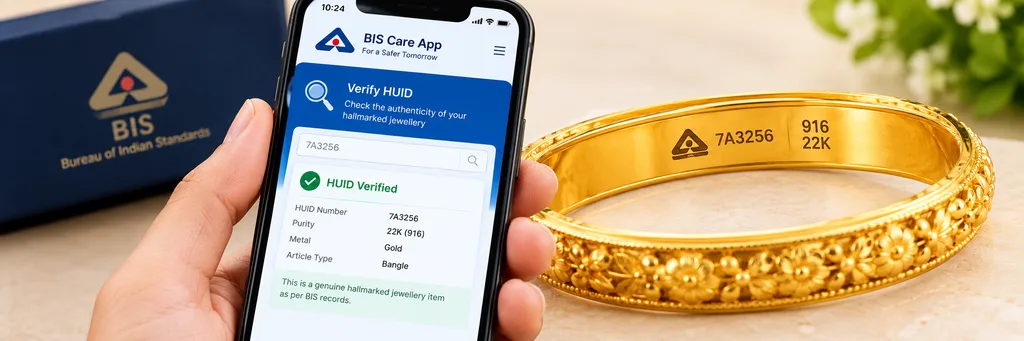
You can also check whether the article carries an HUID and use the BIS Care App to verify it.
These steps can provide useful information, but visual inspection alone cannot measure the exact gold content throughout the entire article.
BIS provides consumers with a more formal option: jewellery or samples can be tested at a BIS-recognized Assaying & Hallmarking Centre on a chargeable basis.
How to Check Gold Purity With HUID?
Another important step in a modern gold purity check is understanding the HUID.
HUID means Hallmark Unique Identification. BIS states that the HUID is a six-digit alphanumeric number that is unique to each hallmarked gold jewellery item and traceable.
The HUID can be verified using the BIS Care App through its Verify HUID feature. BIS says the app allows consumers to verify the authenticity of hallmarked jewellery items carrying a HUID number.
This is particularly useful when you want to verify information associated with a hallmarked jewellery item rather than relying only on what you are told at the time of purchase.
How to Verify a Gold Hallmark Before Buying?
If you are wondering how to verify BIS hallmark on gold jewellery, begin by looking closely at the marks on the article.
Check for the BIS logo.
Check the purity and fineness marking.
Check the HUID number.
Use the BIS Care App to verify the HUID.
Also ask for the authentic invoice.
BIS consumer guidance says an authentic bill or invoice is necessary for the hallmarked article. It also specifies that the invoice should include information such as the article description, net weight of precious metal, purity in carat and fineness, and hallmarking charges.
These checks are especially useful when purchasing higher-value jewellery.
Is a Home Gold Purity Test Accurate?
Searching for a gold purity test may lead you to home methods involving magnets, water, scratching, acids or other informal techniques.
These methods should be treated cautiously.
A simple home experiment may provide a rough indication of certain properties, but it should not be treated as an official purity determination.
For example, a magnet test cannot by itself establish the exact gold content of jewellery.
Similarly, visual colour, weight or appearance cannot prove purity.
When you need a more reliable assessment of jewellery purity, BIS provides access to recognised Assaying & Hallmarking Centres where consumers can have jewellery or samples tested.
How Is Gold Purity Professionally Tested?
Professional gold purity testing is different from an informal home check.
BIS guidance states that consumers can bring jewellery or samples to a BIS-recognized Assaying and Hallmarking Centre for testing. The centre can issue an assay report identifying the jewellery as marked.
BIS’s published guidance on testing consumer jewellery also describes XRF as a non-destructive preliminary method that assesses the surface, while fire assay is a destructive method used for gold-content determination.
This distinction is important because a surface measurement and the composition of the entire article are not necessarily the same thing.
For an old or unhallmarked piece where purity is uncertain, professional testing can therefore be more appropriate than relying on a simple home check.
How to Check Gold Purity of Old Jewellery?
Old jewellery may not have the same markings or documentation as newer hallmarked jewellery.
If you inherited an old necklace, bangle, chain, ring or other item, do not assume its purity solely from its age, colour or previous owner’s statement.
You can inspect the piece for any visible markings and compare the information with available purchase records.
When you need a formal purity assessment, BIS says consumers can take jewellery or samples to a BIS-recognized Assaying & Hallmarking Centre for testing.
This can be especially helpful before selling, exchanging, redesigning or valuing old gold jewellery.
How to Check 916 Gold Purity?
To check 916 gold purity, start by examining the article for its hallmark and fineness marking.
A 916 fineness marking corresponds to 22-karat gold.
Next, look for the HUID and use the BIS Care App’s Verify HUID feature where applicable.
Then review the invoice or other purchase documentation.
Do not judge 916 gold only by its colour or shine. Jewellery finishing can vary significantly depending on design and workmanship.

How to Check 750 Gold Purity?
To check 750 gold purity, look for the applicable hallmark and the 750 fineness marking.
750 corresponds to 18-karat gold.
The article should also carry the applicable hallmark information and HUID where the current hallmarking system applies.
Just like 916 gold, 750 gold should be evaluated using its markings and documentation rather than appearance alone.
Understanding both 916 and 750 makes it easier to compare different jewellery products.
916 Gold vs 750 Gold: Which Should You Choose?
The question of 916 gold vs 750 gold comes up frequently among jewellery buyers.
916 corresponds to 22K gold.
750 corresponds to 18K gold.
The purity difference affects the proportion of gold represented by the fineness marking.
However, the right jewellery choice depends on more than purity alone.
Think about how frequently you will wear the piece, the type of design you want, the weight you prefer, the occasion and your budget.
For a traditional jewellery purchase, you may compare several 22K916 designs.
For a contemporary piece, you may also explore 18K750 alternatives.
Instead of asking which purity is universally best, compare which option suits the particular jewellery you want to purchase.
Gold Purity Check Before Buying Online
When buying gold jewellery online, a digital product page should give you enough information to make a considered decision.
Review the product name.
Check the gold purity.
Look at the product weight.
Review dimensions and size information.
Examine the jewellery images carefully.
Check hallmark and HUID-related information where applicable.
Read the return, exchange and delivery terms.
Review payment and customer-support information.
Good product information can reduce confusion before placing an order.
For customers comparing jewellery online, these details are more useful than simply relying on a promotional photograph.
You can browse the Gold Jewellery collection at Sneha Fine Jewels to explore different jewellery styles and product categories.
Gold Jewellery in Vijayawada: What Buyers Should Check
For anyone searching for gold jewellery in Vijayawada, comparing jewellery stores can involve more than looking at design.
Ask about purity.
Check hallmark information.
Verify HUID where applicable.
Ask for the invoice.
Compare the total price.
Understand the product weight.
Review return and exchange policies.
You can also compare different product categories such as necklaces, rings, chains, bangles, earrings and pendants according to your needs.
Sneha Fine Jewels offers gold and other jewellery collections that customers can explore online.
For customers searching for a gold jewellery shop in Vijayawada or a gold jewellery store in Vijayawada, these same purity and documentation checks remain useful.
How to Buy Genuine Gold Jewellery Safely
Knowing how to know if gold jewellery is genuine requires more than one quick observation.
Start with hallmark information.
Understand the purity marking.
Verify HUID through the BIS Care App where applicable.
Check the invoice.
Read the product description.
Understand the total price.
Keep purchase documentation safely after the transaction.
BIS also says that jewellers should display their BIS registration certificate, and consumers should be able to see the hallmark using suitable magnification.
These steps give buyers a more structured way to evaluate jewellery.
Why Gold Purity Matters When Buying Jewellery
Gold purity matters because the purity level tells you about the fineness of the precious metal.
A customer who understands terms such as 22K, 18K, 916 and 750 can compare different jewellery products more confidently.
Purity should be considered together with product weight, design, workmanship, price and intended use.
This is especially important for substantial purchases such as bridal necklaces, gold chains and bangles.
For smaller purchases such as rings or pendants, the same principle applies.
Knowing what you are buying helps you compare products more effectively.
What Should Be Included in a Gold Jewellery Invoice?
An invoice is an important part of the buying process.
BIS consumer guidance states that the bill or invoice for hallmarked precious-metal articles should include the description of each article, net weight of precious metal, purity in carat and fineness, and hallmarking charges.
Keep the invoice after your purchase.
It can be useful for records, future reference and complaint redressal.
For a valuable jewellery purchase, proper documentation should be treated as an essential part of the transaction.
What If a Hallmarked Jewellery Item Has Lower Purity?
Consumers may naturally worry about what happens when the purity of a hallmarked article is lower than the marked purity.
BIS consumer-protection guidance states that when hallmarked jewellery is found to have lower purity than the purity marked on the jewellery, the customer is entitled to compensation under the applicable rules, including two times the difference calculated for the shortage of purity based on the weight of the article sold, along with testing charges.
Consumers can also use BIS complaint and testing mechanisms where appropriate.
This is one reason why retaining your invoice and purchase documentation is important.
Frequently Asked Questions About Gold Purity
Start by checking the applicable hallmark and fineness marking. You can also verify the HUID using the BIS Care App. For formal testing, BIS says consumers can use a BIS-recognized Assaying & Hallmarking Centre.
916 is a gold fineness marking corresponding to 22-karat gold. BIS lists 22K(916) among the permitted hallmarking grades.
750 is a fineness marking corresponding to 18-karat gold. BIS lists 18K(750) among the permitted hallmarking grades.
Look for the applicable hallmark and 916 fineness marking, check the HUID and verify it through the BIS Care App where applicable. Also request the authentic invoice.
Look for the applicable hallmark and 750 fineness marking and review the HUID and invoice details.
Use the BIS Care App and its Verify HUID feature. BIS says HUID is unique to each hallmarked item and traceable.
A simple home test should not be treated as a definitive purity determination. For a formal assessment, consumers can use a BIS-recognized Assaying & Hallmarking Centre.
Yes. A fineness of 916 corresponds to 22-karat gold.
Yes. A fineness of 750 corresponds to 18-karat gold.
Check the applicable BIS hallmark, purity marking and HUID, verify the HUID through the BIS Care App where applicable, and obtain an authentic invoice.
Official BIS Gold Purity Resources
For the latest official information about hallmarking, gold purity and consumer protection, read the BIS Hallmarking Overview.
You can also check the official BIS Consumer Protection information for information about HUID verification, jewellery testing and consumer rights.
Explore Gold Jewellery at Sneha Fine Jewels
Customers looking for gold jewellery online can explore different styles based on purity, design, weight and occasion.
Sneha Fine Jewels offers jewellery categories for different preferences, including gold jewellery and other precious-metal collections.
You can start with the Sneha Fine Jewels website and explore available products.
You can also add relevant internal links from this article to your existing Gold, Diamond, Silver, Bridal and individual product-category pages.
For anyone searching for gold jewellery in Vijayawada, learning how to evaluate purity before purchasing can make the shopping process much easier.
Final Thoughts on How to Check Gold Purity
Learning how to check gold purity does not mean relying on a single test or a single number.
Start with the applicable BIS hallmark.
Understand the purity marking.
Know the difference between 916 and 750.
Understand what HUID means.
Verify HUID through the BIS Care App where applicable.
Ask for the correct invoice.
For uncertain or old jewellery, consider professional testing through a BIS-recognized Assaying & Hallmarking Centre.
These steps can help you make more informed decisions when buying, selling, exchanging or evaluating gold jewellery.